
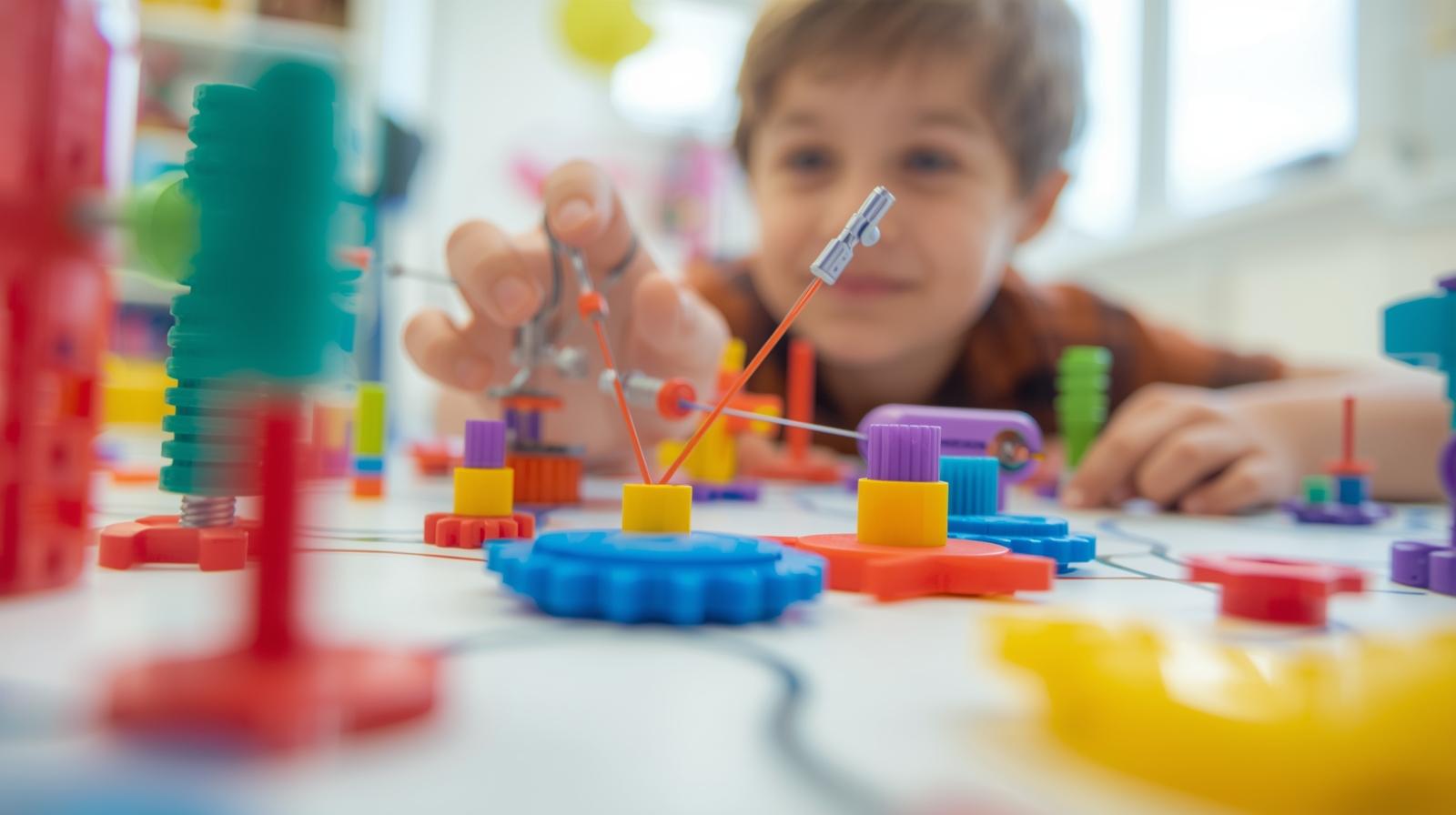
Children between the ages of 7 and 10 often become fascinated by how the world works. They start asking deeper questions like:
- Why do objects fall?
- How do magnets attract?
- What makes things move?
This natural curiosity makes it the perfect age to introduce physics concepts through play.
Hands-on physics toys help children explore ideas like motion, force, gravity, magnetism, and energy without feeling like they’re studying. Instead of reading about science in a textbook, kids see it happen right in front of them.
For parents and teachers, the right physics toy can turn ordinary playtime into a powerful learning experience.
Below are some of the best hands-on physics toys that make science exciting for curious kids.
Why Physics Toys Are Great for Ages 7–10
At this age, children are developing stronger logical thinking and problem-solving skills.
Physics toys support this development by helping kids:
Understand Cause and Effect
Kids see how actions create reactions. For example, pushing a ball harder makes it move faster.
Learn Through Experimentation
Children naturally test ideas like:
- What happens if I build the tower taller?
- Will this magnet attract that object?
Build Confidence in STEM
When kids successfully complete experiments or build moving models, they feel proud and excited about science.
Best Hands-On Physics Toys for Curious Kids
1. Marble Run Physics Sets
Marble run sets are one of the best introductions to physics concepts.
Kids build tracks where marbles roll through loops, drops, and tunnels.
Physics Concepts Learned
- Gravity
- Acceleration
- Momentum
- Engineering design
Why Kids Love It
Children enjoy designing their own tracks and watching marbles race down the course.
Every change in the design creates a new experiment.
2. Magnetic Construction Sets
Magnetic building toys allow kids to create towers, vehicles, bridges, and geometric structures.
Magnets make construction easier while still encouraging creativity.
Physics Concepts Learned
- Magnetism
- Structural balance
- Geometry
- Stability
Why Parents Love It
These toys combine science, engineering, and creativity in one activity.
Kids can play alone or collaborate with friends and siblings.
3. Simple Machines Engineering Kits
Engineering kits that teach simple machines are fantastic for young learners.
These kits allow kids to build working models like:
- Pulleys
- Levers
- Gears
- Catapults
Physics Concepts Learned
- Force
- Mechanical advantage
- Energy transfer
Real-World Connection
Kids begin to understand how machines in everyday life work, such as cranes, bicycles, and elevators.
4. STEM Catapult and Launcher Kits
Launcher kits allow kids to build devices that shoot foam balls or small objects.
They are exciting and educational at the same time.
Physics Concepts Learned
- Potential energy
- Motion
- Trajectory
- Force and resistance
Fun Challenge
Children can experiment with:
- Launch angles
- Distance
- Force
This turns playtime into a mini physics lab.
5. Balance and Gravity Experiment Toys
Balance toys often include spinning tops, balancing birds, or gravity puzzles.
These toys appear simple but demonstrate important physics ideas.
Physics Concepts Learned
- Center of gravity
- Balance
- Rotational motion
Kids enjoy trying to balance objects in unusual ways while discovering how weight distribution works.
6. Electricity and Circuit Kits
Some physics toys introduce the basics of electricity and circuits.
Kids can safely build projects such as:
- Simple lights
- Buzzers
- Small fans
Physics Concepts Learned
- Electrical circuits
- Energy transfer
- Conductors and insulators
These kits make abstract physics ideas visible and interactive.
How to Choose the Right Physics Toy
Not every toy suits every child. Here are a few tips when choosing physics toys for ages 7–10.
Choose Hands-On Activities
Look for toys that allow kids to build, experiment, and modify.
Passive toys don’t provide the same learning value.
Pick Toys That Grow With the Child
Good STEM toys offer multiple levels of difficulty.
Kids should be able to create simple builds first and more advanced ones later.
Encourage Creativity
The best physics toys allow open-ended exploration, where kids can invent their own designs.
How Parents Can Make Physics Toys More Educational
You don’t need to be a scientist to help your child learn from these toys.
Try asking simple questions like:
- Why do you think the marble moved faster on that track?
- What happens if we make the ramp steeper?
- Can we build a taller tower?
These questions encourage scientific thinking and curiosity.
Benefits of Hands-On Physics Toys
Physics toys do more than teach science.
They also help children develop:
Critical Thinking
Kids learn to test ideas and solve problems logically.
Creativity
Many physics toys involve building unique designs and structures.
Persistence
Experiments don’t always work the first time, which teaches patience and resilience.
STEM Confidence
Children who enjoy early science activities often become more interested in engineering, robotics, and technology later.
Final Thoughts
Physics is everywhere in our daily lives—from the way a ball bounces to how airplanes fly.
Introducing children to these ideas through hands-on physics toys makes learning exciting instead of intimidating.
For curious kids aged 7 to 10, the right physics toy can spark a lifelong love of science.
Whether it’s building marble tracks, experimenting with magnets, or launching projectiles, these toys turn playtime into real scientific discovery.