
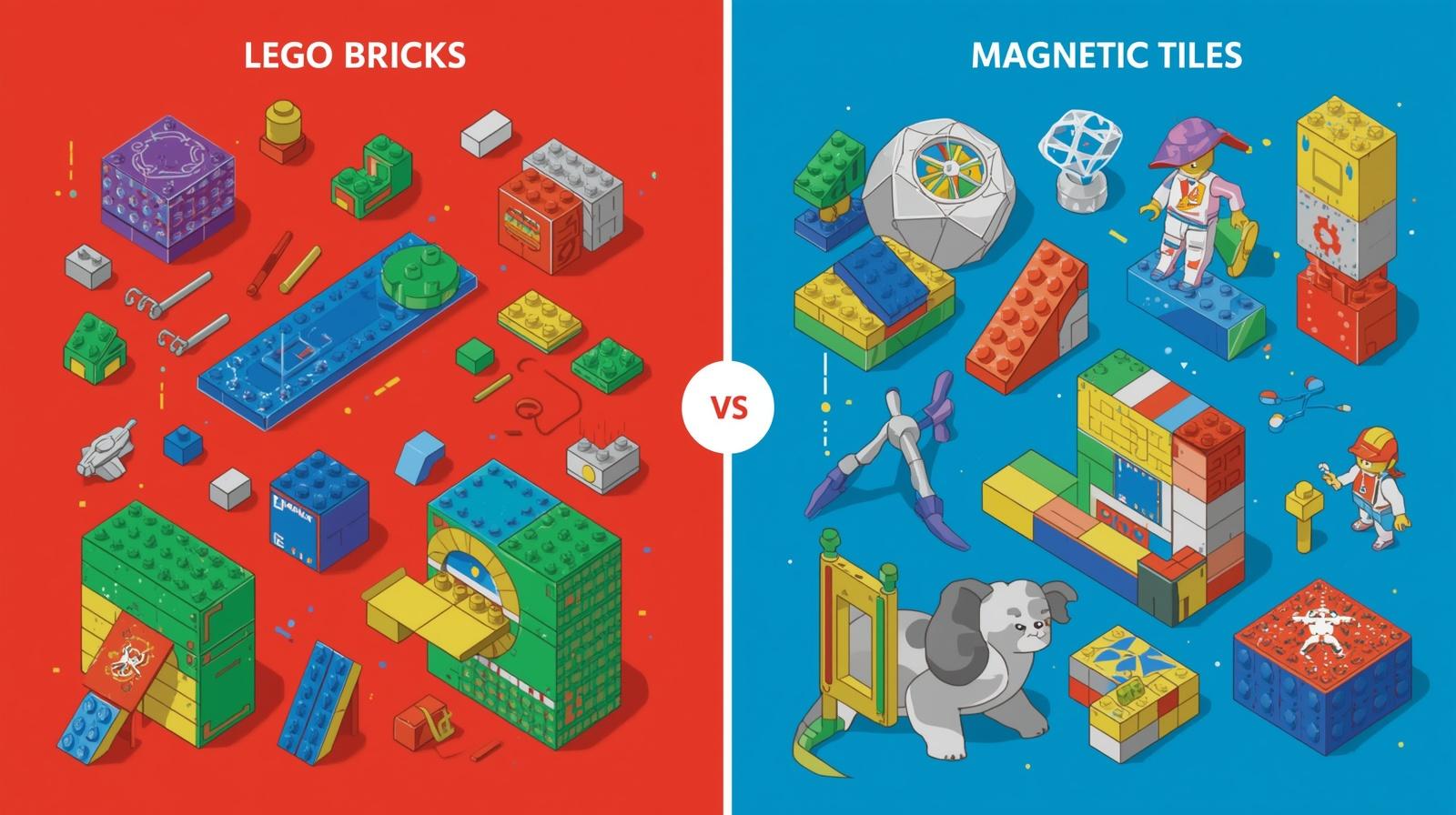
If you’re choosing a building toy for your child, you’ve probably narrowed it down to two popular options:
LEGO or magnetic tiles.
Both are loved by kids. Both claim to support STEM learning. And both can keep children busy for hours.
But when it comes to real skill development, they are not the same.
Some parents notice their child gets deeply focused with LEGO. Others see more creativity and faster engagement with magnetic tiles.
So which one actually builds better skills?
Let’s break it down in a practical, parent-focused way.
What Is LEGO?
LEGO is a classic building system made of interlocking plastic bricks.
Kids can:
- Follow instructions to build specific models
- Create their own designs from scratch
- Build everything from simple houses to complex machines
It’s structured, detailed, and often requires patience.
What Are Magnetic Tiles?
Magnetic tiles are colorful geometric shapes with magnets on the edges.
Kids can:
- Snap pieces together instantly
- Build 2D and 3D shapes
- Create structures without worrying about pieces falling apart easily
They are more intuitive and easier to use, especially for younger children.
Quick Comparison: LEGO vs Magnetic Tiles
| Feature | LEGO | Magnetic Tiles |
|---|---|---|
| Difficulty | Medium to High | Easy to Medium |
| Learning Style | Structured | Open-ended |
| Best For | Focus, logic, precision | Creativity, exploration |
| Age Range | 5+ (some sets 7+) | 2+ to 8+ |
| Frustration Level | Higher | Lower |
Popular Picks Parents Usually Choose
Here are the types of products most parents end up comparing:
These represent the typical experience:
- LEGO ranges from simple to highly complex
- Magnetic tiles stay creative and frustration-free
Skill-by-Skill Breakdown
1. Creativity
Magnetic tiles make creativity easy.
Kids can build anything within seconds. There are no strict rules, no complicated steps, and very little frustration.
LEGO also supports creativity, but it often starts with instructions. Many kids follow guides instead of exploring freely.
If your goal is immediate creative expression, magnetic tiles have the edge.
If you’re interested in open-ended play, this explains why it matters:
Why Open-Ended STEM Toys Beat Flashy Gadgets Every Time
2. Problem-Solving Skills
LEGO is stronger here.
Building a LEGO model requires:
- Following sequences
- Fixing mistakes
- Understanding how parts connect
This develops structured thinking and problem-solving.
Magnetic tiles involve problem-solving too, but in a more relaxed, less structured way.
3. Focus and Attention
LEGO tends to hold attention longer—especially for kids who enjoy challenges.
Completing a build can take time and concentration.
Magnetic tiles are engaging, but sessions are often shorter unless kids create larger projects.
If improving focus is important, this guide can help:
Top STEM Toys That Improve Focus and Attention
Toys That Keep Kids Engaged the Longest
Some building toys naturally lead to longer play sessions.
In general:
- LEGO wins for long, focused sessions
- Magnetic tiles win for quick, repeatable play
4. Fine Motor Skills
LEGO is better for fine motor development.
The small pieces require precision, finger strength, and control.
Magnetic tiles are larger and easier to handle, which makes them great for younger kids—but less challenging for motor skill growth.
5. Frustration vs Confidence
This is where parents notice a big difference.
LEGO can be frustrating:
- Pieces don’t always fit easily
- Builds can collapse
- Instructions can be challenging
That frustration can be good for growth—but not for every child.
Magnetic tiles are almost frustration-free:
- Pieces snap together instantly
- Builds are stable
- Kids feel successful quickly
If your child gets bored or frustrated easily, this post is helpful:
Best STEM Toys for Kids Who Get Bored Easily (Tested by Parents)
Which One Is Better by Age?
Ages 2–4
Magnetic tiles are the better choice.
They are safe, simple, and easy to use.
Ages 5–7
Both work well.
Magnetic tiles for creativity, LEGO for early problem-solving.
Ages 8+
LEGO becomes more valuable.
Kids can handle complexity and enjoy detailed builds.
Screen-Free Learning Value
Both options are excellent alternatives to screen time.
If your goal is to reduce device usage, either choice is better than apps.
This guide shows how to do that effectively:
How to Use STEM Toys to Reduce Screen Time
Final Verdict
There’s no single winner—it depends on your goal.
Choose LEGO if you want:
- Strong problem-solving skills
- Better focus
- More structured learning
Choose magnetic tiles if you want:
- Creativity and imagination
- Easy, frustration-free play
- Younger kids to stay engaged
The Best Choice for Most Parents
Many parents don’t choose one—they use both.
Magnetic tiles for:
- Quick play
- Creative exploration
LEGO for:
- Deeper thinking
- Challenging builds
This combination gives your child a more complete learning experience.
FAQ
Are magnetic tiles educational?
Yes. They teach spatial awareness, creativity, and basic engineering concepts.
Is LEGO too difficult for younger kids?
Some sets are. But beginner sets are designed for ages 4–5 and up.
Which lasts longer?
LEGO tends to last longer as kids grow, especially advanced sets.
Which is better for reducing screen time?
Both are excellent. The best choice depends on what your child enjoys more.