
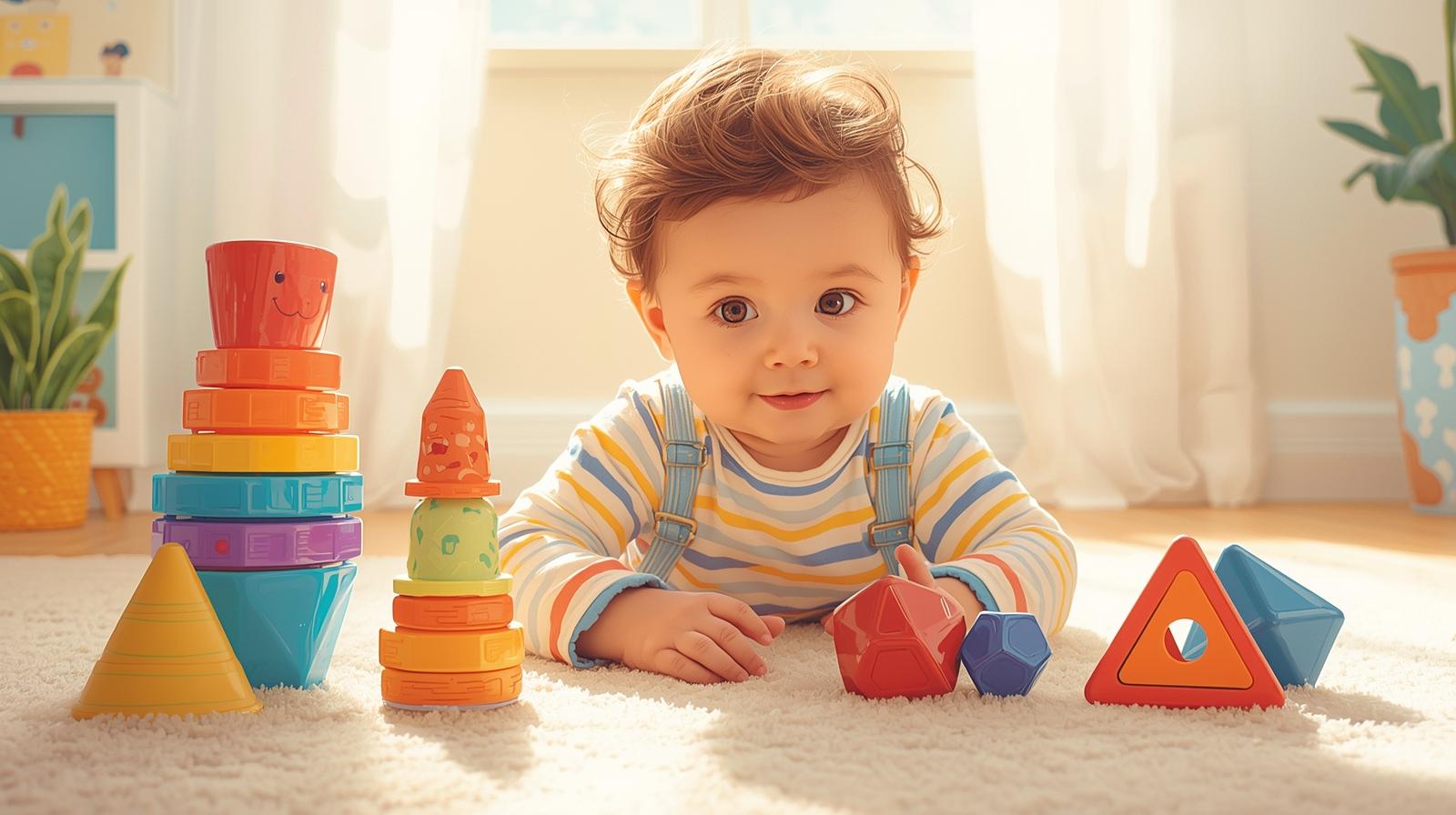
When your child turns one, toys suddenly matter a lot more than they used to. This is the age when babies stop just observing the world and start actively testing it.
They drop things on purpose.
They stack, knock over, repeat.
They watch closely to see what happens next.
That’s STEM learning — just without the label.
STEM toys for 1 year old aren’t about teaching coding or math formulas. They’re about building the brain’s foundation through hands-on exploration, movement, and curiosity.
This guide breaks down what STEM toys actually mean at this age, which ones are worth buying, and how to avoid wasting money on toys that look educational but don’t support real learning.
What STEM Really Means for 1 Year Olds
At 12–24 months, children are developing rapidly in five key areas:
- Cause and effect
- Fine and gross motor skills
- Spatial awareness
- Early problem solving
- Sensory processing
The best STEM toys support these skills naturally, through play — not instruction.
If a toy requires a screen, complex rules, or constant adult direction, it’s not age-appropriate STEM for a one-year-old.
Best Types of STEM Toys for 1 Year Old
1. Stacking and Nesting Toys
Stacking cups, rings, and nesting blocks are some of the most powerful early STEM tools — and they look deceptively simple.
Toddlers experiment with balance, height, size, and gravity. When a tower falls, they’re learning cause and effect. When they try again, they’re building persistence.
Skills developed:
- Spatial reasoning
- Size comparison
- Hand-eye coordination
2. Shape Sorters With Large, Safe Pieces
Shape sorters introduce early logic and geometry. At first, toddlers may just dump pieces out — and that’s okay. Eventually, they begin matching shapes to openings.
This trial-and-error process is critical for cognitive development.
Skills developed:
- Problem solving
- Shape recognition
- Fine motor control
3. Cause-and-Effect Toys
Toys where pressing, pulling, or turning something leads to a clear result are gold at this age.
Think pop-up toys, rolling balls, simple levers, or buttons that trigger motion — not flashing lights.
Skills developed:
- Logical thinking
- Prediction
- Attention span
4. Large Building Blocks
Soft blocks, foam blocks, or oversized wooden blocks allow toddlers to build without frustration.
Even stacking two blocks is meaningful learning at this stage. When structures fall, children learn about balance and stability.
Skills developed:
- Early engineering concepts
- Motor planning
- Persistence
5. Sensory STEM Toys
Sensory play supports early scientific thinking. Toys with different textures, weights, and resistance help toddlers explore the physical properties of objects.
Safe sensory balls, textured blocks, or simple discovery bins work well.
Skills developed:
- Sensory processing
- Observation
- Curiosity
6. Rolling and Motion Toys
Balls, push toys, and ramps introduce toddlers to movement and speed.
Watching something roll away — and chasing it — teaches early physics concepts and strengthens coordination.
Skills developed:
- Motion tracking
- Cause and effect
- Gross motor skills
7. Simple Wooden Puzzles
Large-knob puzzles with basic shapes or familiar objects encourage toddlers to test fits and placements.
These puzzles also promote patience — a skill that develops slowly but starts here.
Skills developed:
- Visual matching
- Coordination
- Problem solving
How to Choose the Right STEM Toy for a 1 Year Old
Before buying, ask these questions:
Is it safe?
No small parts, smooth edges, non-toxic materials.
Is it simple?
Too many features overwhelm toddlers and reduce deep play.
Can it be played with in multiple ways?
Open-ended toys grow with your child.
Does it invite action, not observation?
Hands-on play always beats passive entertainment.
What to Avoid (Even If the Box Says “Educational”)
- Screen-based toys
- Loud, flashing plastic toys with no interaction
- Toys that only do one thing
- Overly complex “learning systems” meant for older kids
If your toddler can’t manipulate it independently, it’s not the right STEM toy yet.
How Parents Can Support STEM Play at This Age
You don’t need to teach — just observe and engage.
- Sit nearby and narrate what’s happening
- Use simple language like “up,” “down,” “in,” and “out”
- Let your child repeat actions as much as they want
- Rotate toys every week to renew interest
The goal is curiosity, not performance.
Why STEM Toys Matter So Early
Research consistently shows that early hands-on play supports long-term cognitive development, language growth, and problem-solving skills.
STEM toys at one year old don’t create geniuses overnight — but they build the neural pathways that future learning depends on.