
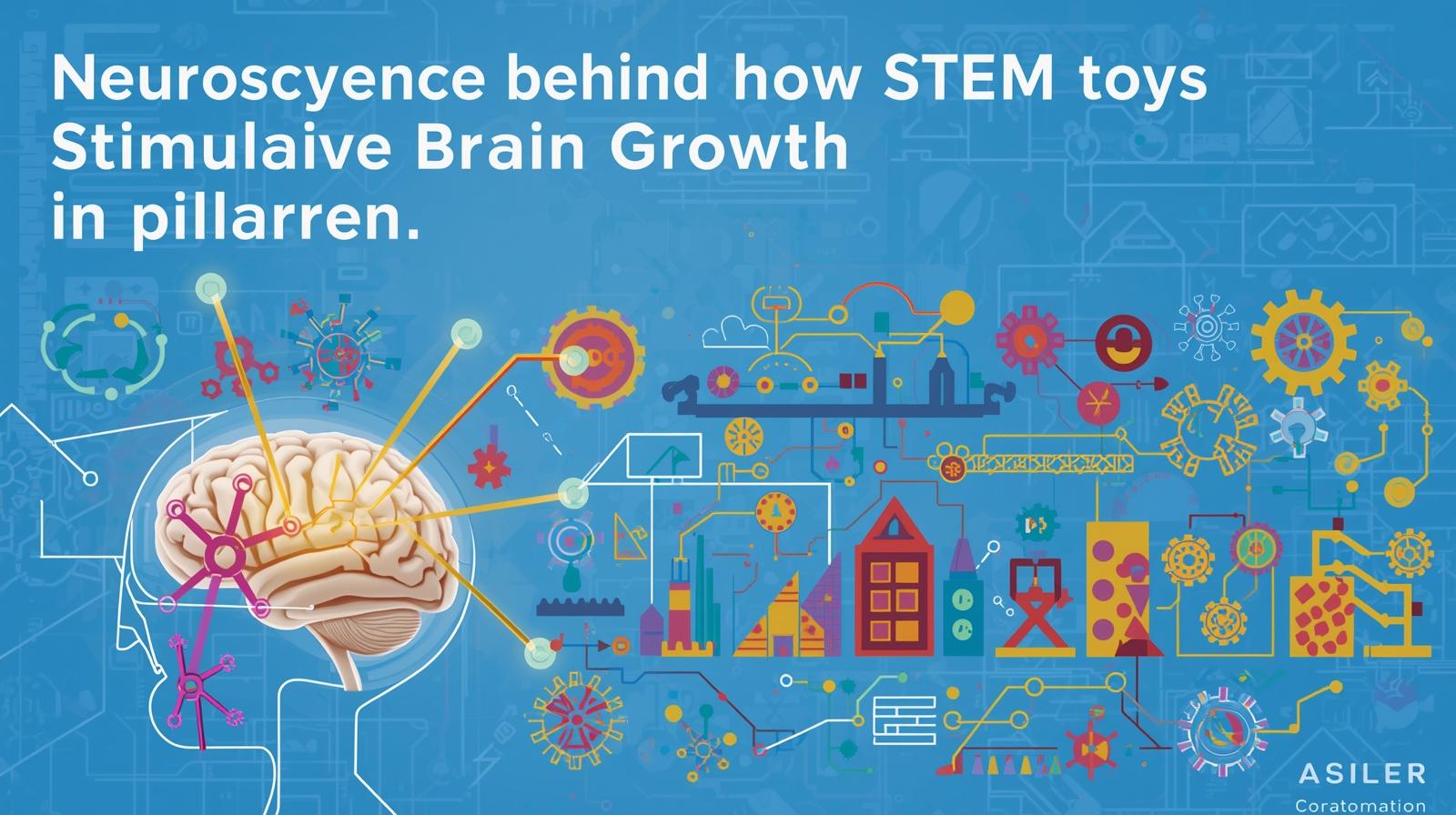
When people say STEM toys are “good for the brain,” it can sound vague or exaggerated.
But neuroscience tells a very clear story.
The way children’s brains grow, wire, and strengthen connections is directly shaped by what they do — especially during play. STEM toys happen to align almost perfectly with how the brain is designed to learn.
Here’s what’s really happening inside your child’s brain when they play with STEM toys.
Brain Growth Happens Through Connections, Not Facts
A child’s brain doesn’t grow by memorizing information. It grows by forming and strengthening neural connections.
Every time a child:
- Tries something new
- Solves a problem
- Adjusts after a mistake
- Thinks through a challenge
Neurons fire together. And when neurons fire together repeatedly, they wire together.
STEM toys naturally create these repeated, meaningful brain connections.
Hands-On Play Activates Multiple Brain Regions at Once
Neuroscience shows that the strongest learning happens when multiple areas of the brain are active simultaneously.
STEM toys do exactly that.
During hands-on play, kids use:
- The motor cortex for building and manipulating
- The prefrontal cortex for planning and decision-making
- The parietal lobe for spatial awareness
- Emotional centers for motivation and persistence
This whole-brain activation leads to deeper learning and stronger neural pathways.
Problem-Solving Strengthens the Prefrontal Cortex
The prefrontal cortex is responsible for:
- Focus
- Planning
- Self-control
- Logical thinking
It’s also one of the last parts of the brain to fully mature.
STEM toys gently exercise this area by asking kids to:
- Follow sequences
- Predict outcomes
- Hold ideas in working memory
- Adjust strategies
Each challenge acts like a workout for executive function skills.
Struggle Is a Feature, Not a Bug
Neuroscience confirms something parents often find uncomfortable: struggle is essential for brain growth.
When a child encounters difficulty and keeps trying, the brain releases chemicals that strengthen learning and memory.
STEM toys are designed with just enough challenge to:
- Trigger effort
- Encourage persistence
- Reward problem-solving
That productive struggle builds resilience at a neurological level.
Repetition With Variation Builds Stronger Neural Pathways
The brain loves repetition — but only when there’s variation.
Open-ended STEM toys allow kids to repeat activities while changing the approach each time. That combination strengthens neural pathways far more than one-time tasks.
This is why kids return to the same STEM toy again and again without getting bored.
Spatial Reasoning Shapes Long-Term Cognitive Ability
Building and engineering-based toys develop spatial reasoning — the ability to visualize and manipulate objects mentally.
Neuroscience research links strong spatial skills to:
- Higher math performance
- Better problem-solving ability
- Stronger STEM aptitude later in life
When kids build, stack, rotate, and design, they are literally training their brains to think in three dimensions.
Cause and Effect Builds Predictive Thinking
STEM toys constantly ask the brain to predict outcomes.
“If I do this, what will happen?”
This strengthens neural circuits related to reasoning and anticipation — skills essential for science, engineering, and everyday decision-making.
Over time, kids become better thinkers because their brains learn to anticipate consequences.
Emotion and Learning Are Closely Linked
The brain learns best when emotions are involved.
STEM toys naturally create emotional engagement:
- Excitement when something works
- Frustration when it doesn’t
- Pride after solving a challenge
These emotions release neurotransmitters that enhance memory and learning.
This is why kids often remember lessons learned through play better than anything taught through instruction alone.
Why Screens Don’t Build the Brain the Same Way
Passive screen experiences activate far fewer neural pathways.
Most screens provide answers instantly, leaving little room for effort, exploration, or deep thinking.
STEM toys slow the brain down and invite it to work — which is exactly how neural growth happens.
Brain Growth That Lasts
The most powerful part of STEM play is that it builds how the brain learns, not just what it learns.
Kids develop:
- Flexible thinking
- Curiosity-driven learning
- Persistence
- Confidence in problem-solving
These traits are neurologically embedded through repeated experiences.
Final Thoughts
STEM toys don’t magically make kids smarter.
They do something better.
They give the brain what it needs to grow — challenge, curiosity, movement, emotion, and time.
When kids play with STEM toys, they aren’t just playing. They’re literally building their brains, one connection at a time.